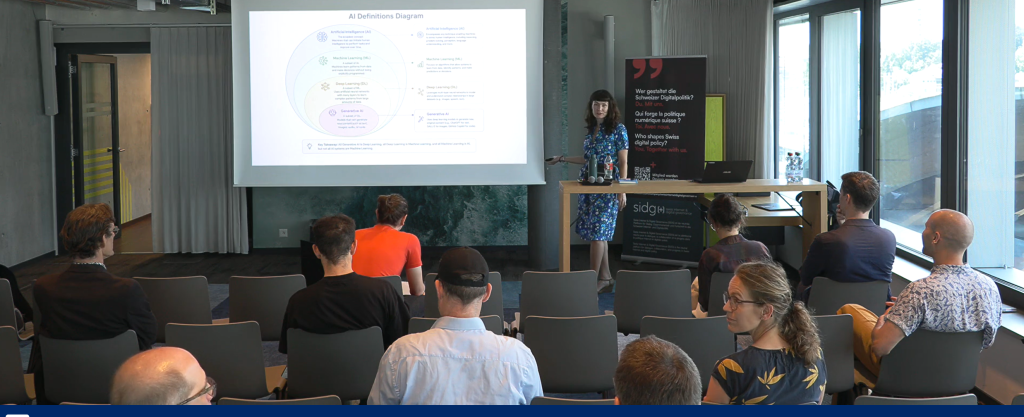
On 16 June 2026, the Swiss Internet Governance Forum (IGF) 2026 convened in Bern to address the local, regional, and global most pressing digital policy challenges. Bringing together a diverse array of stakeholders from government, civil society, academia, and the private sector, the forum explored critical facets of digital agency, cybersecurity, democratic governance, and inclusive digitalisation. A powerful preliminary perspective was delivered by the Swiss Youth IGF, which advocated for greater platform accountability, mandatory digital literacy courses, and robust governance of generative AI to mitigate its psychological, social, and environmental strains—particularly its heavy water consumption.
Spotlight on Session 6: Aligning Artificial Intelligence with Climate Action
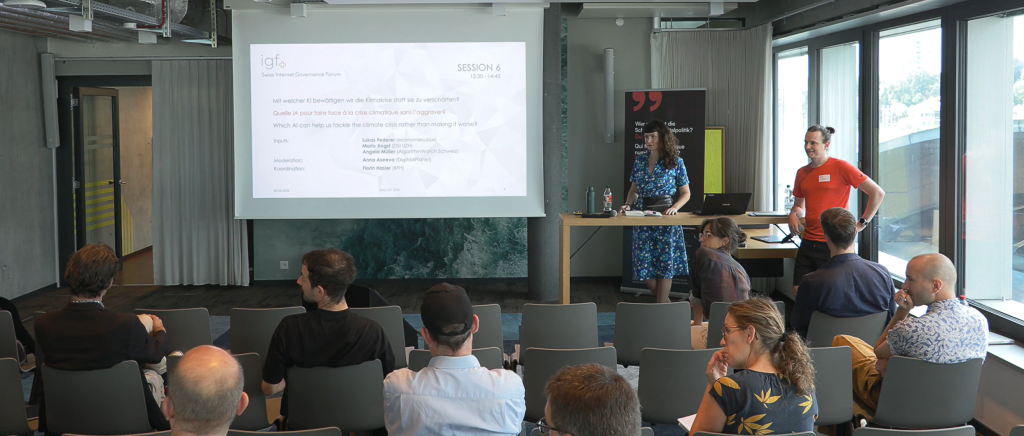
Dr. Anna Aseeva, Policy and Sustainability Expert at Digital for Planet, moderated Session 6 on ‘AI and Sustainability’. A primary highlight aimed at answering the question: Which AI can help us tackle the climate crisis rather than making it worse? The session was coordinated by Florin Hasler (BFH) and Fabio Monnet (Swiss Youth IGF), with the following input speakers: Lukas Federer (economiesuisse), Mario Angst (DSI UZH), and Angela Müller (AlgorithmWatch CH).
As the global deployment of AI accelerates at an unprecedented pace, this session dove into the environmental nuances of the technology, distinguishing between the impacts of machine learning, large language models (LLMs), and small language models (SLMs). Participants scrutinised the exact impacts of data centres and of overall computing power, contrasting beneficial uses—such as optimising the energy efficiency of buildings—against counterproductive practices, such as leveraging AI to discover more fossil fuels.
The session yielded several pivotal takeaways crucial for future sustainable digital policies:
- ‘AI is not AI’: the environmental viability of AI cannot be generalised; its ultimate impact depends heavily on the specific use case.
- A shift toward specialisation: rather than pouring resources indiscriminately into generalised, consumer-facing models, participants emphasised that investments should prioritise specialised AI models engineered explicitly to solve the climate crisis.
- Regional capacity and competitiveness: concurrently, some perspectives highlighted the necessity of investing in general AI capacities and local data centers within Switzerland and Europe to maintain global economic competitiveness and sovereignty.
- Measuring the ‘Footprint’ vs. the ‘Handprint’: to establish meaningful regulation and policymaking, the community called for higher-quality data and evidence that accurately measures both the ecological ‘footprint’ (the resource consumption of AI) and its potential positive ‘handprint’ (the environmental problems AI helps resolve).
Broader Commitments to Digital Responsibility
Beyond the climate-centric debates of the Session 6, the 2026 edition of Swiss IGF underscored that technological advancements must remain bound to human-centric principles. Discussions on democratic governance championed a ‘Society in the Loop’ model, insisting that civic values must be integrated throughout the entire lifecycle of AI systems—from design to continuous impact evaluation—rather than relying on post-harm checks. Furthermore, participants called for mandatory, open, and user-centered interoperability standards to protect public digital infrastructure, alongside multi-stakeholder dialogues to refine platform regulations and enhance child protection without triggering digital exclusion.
The Digital for Planet Perspective
The outcomes of Swiss IGF 2026—and the critical insights from Session 6—reinforce the core mission of Digital for Planet: digital innovation must not be pursued at the expense of our planet’s finite resources. Shifting our technological architecture toward specialised, climate-focused AI, while rigorously measuring both its operational footprint and its real-world handprint, represents the only sustainable path forward. By implementing these rigorous guardrails, we can ensure that the next generation of digital tools serves as a true ally in the fight against climate change.