
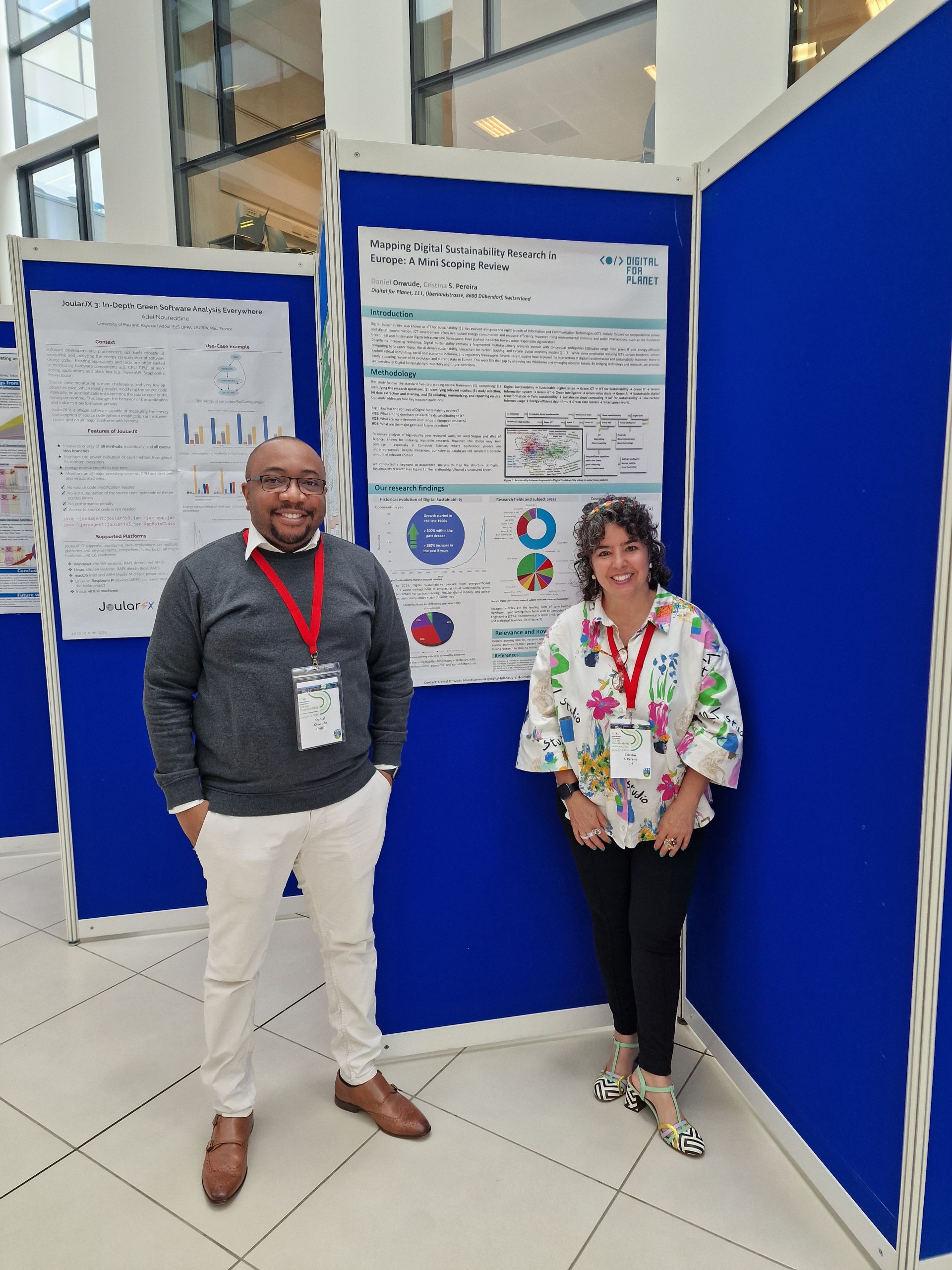
Earlier this month D4P Director, Dr. Cristina Pereira, and D4P Senior Digital Sustainability Expert, Dr. Daniel Onwude attended the ICT for Sustainability International Conference, where they presented a research poster on the mapping digital sustainability research in Europe.
Digital Sustainability, also known as ICT for Sustainability (ICT4S), has evolved alongside the rapid growth of the ICT sector. Initially, ICT development focused on computational power and digital transformation while often overlooking energy consumption and resource efficiency. However, rising environmental concerns and policy interventions, such as the European Green Deal and Sustainable Digital Infrastructure frameworks, have pushed the sector toward more responsible digitalization. Despite its increasing relevance, Digital Sustainability remains a fragmented multidisciplinary research domain with conceptual ambiguities. The short paper is available for download here.
About the ICT4S Conference
The ICT4S conference brings together leading researchers in ICT4S with government and industry representatives with an interest in using, analysing, designing and deploying ICT for environmental and social sustainability. The conference aims to stimulate discussion and movement towards fundamental changes in ICT systems among researchers studying the effects of ICT on sustainability and developers of sustainable ICT systems or applications.
- Data Center Efficiency and Sustainability
- AI and Energy Efficiency
- ICT Sector Greenhouse Gas Emissions
- Sustainable Software Development
- Sustainable AI and Machine Learning
- Embedding Sustainability in Computer Science/ICT Education
- ICT-Induced Behavioral and Societal Change
- Potential of ICT for Economic Growth and Decentralization
- Green E-Commerce
- ICT and the Circular Economy
- Sustainability-Driven Resilience
- Art and Education in ICT4S
The one-week conference is organized into several different tracks. The first and last days were dedicated to hands-on, interactive workshops and symposiums, while the three core days involved keynote speakers and parallel presentations of research papers that were peer-reviewed and selected for the main program.
Keynote: Data Centres and Sustainability
This year, keynote speakers addressed a variety of topics at the intersection of ICT, technology and sustainability.
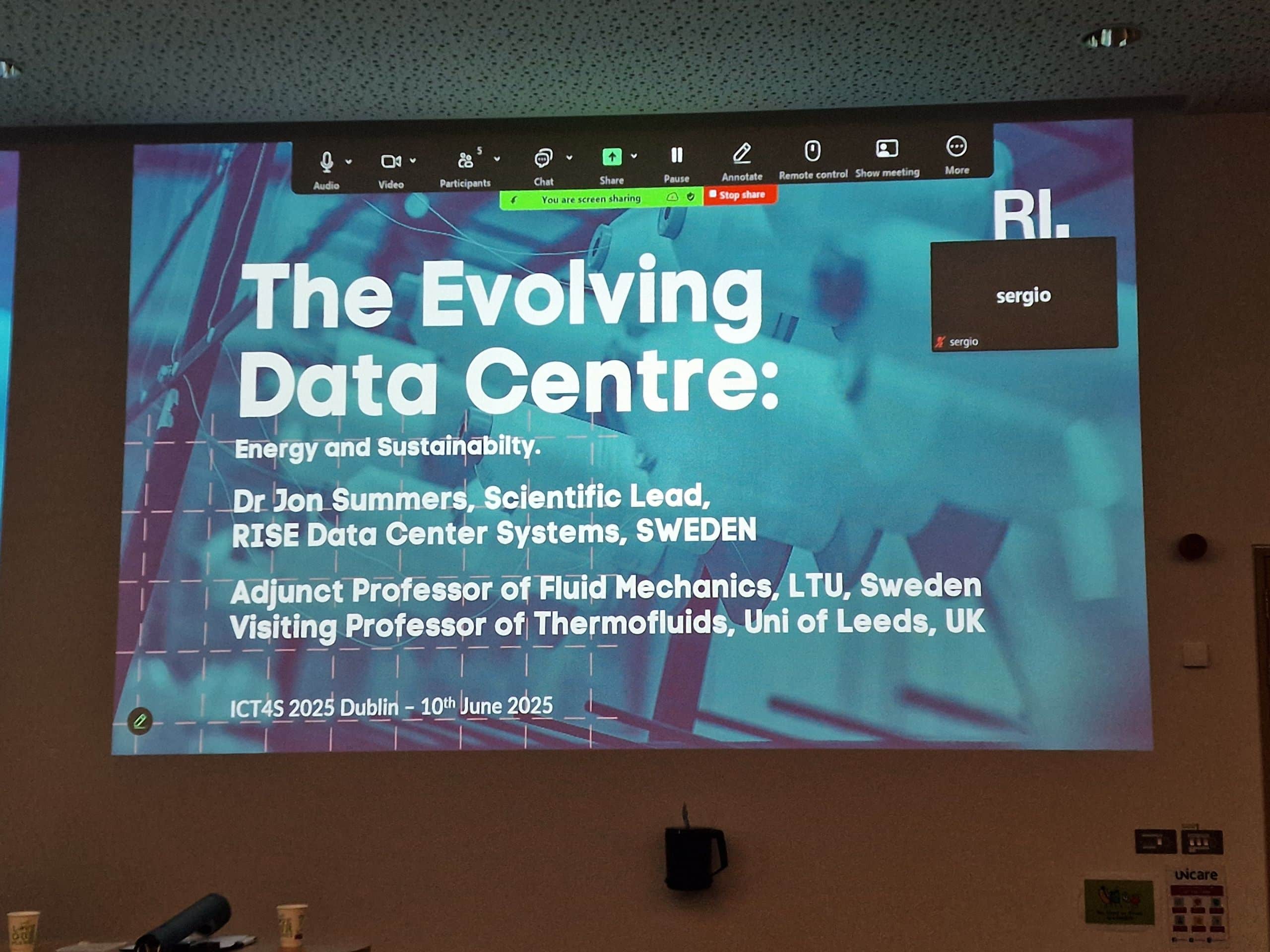
Professor Jon Summers, Scientific Lead in Data Centres at the Research Institutes of Sweden (RISE) enlightened the audience with a deep dive into all aspects of the matter of data centres energy and sustainability, from the ground to the cloud, as well as the key role data centres play in the Nordic countries.
With the evolution of digital infrastructure, data centres face increasing energy demands, complex cooling challenges, and sustainability pressures. The keynote examined the key drivers reshaping data centres, emphasizing energy efficient computing and advanced cooling technologies, whilst considering sustainability. In addition the presentation touched upon operational challenges, focusing on enhancing efficiency, reducing environmental impact, and adapting infrastructure to support future digital ecosystems.
Keynote: A Paradigm Shift in Sustainability Policy
In his keynote address “The Need for a Paradigm Shift – Reshaping Sustainability Policy” Professor Benno Werlen, UNESCO Chair on Global Understanding for Sustainability, at the University of Jena presented the key ideas behind The Jena Declaration. According to Werlen, the current authoritarian developments in world politics endanger the UN Agenda 2030 and its 17 Sustainable Development Goals. A new paradigm shift in sustainability is required, transitioning from a nature-culture logic to a culture-nature nexus and from a top-down to a bottom-up path for societal transformation. The Jena Declaration proposes this shift and calls for a new strategy to achieve sustainable living everywhere while respecting cultural and regional specificities and aesthetics in our relationship with nature.
Keynote: AI Data Centres and Energy Efficiency
Dr. Paolo Bertoldi, chief policy analyst for energy efficiency at the European Commission delivered a keynote address focusing on the energy, climate and water impact of future AI data centres. He emphasized the need to take action to ensure this expected growth is as sustainable as possible, particularly by adopting the most efficient solutions and using renewable energies to power data centres. One areas that requires special attention is software and algorithms efficiency, including definitions and standards. Traditional metrics for capturing data centre efficiency, such as PUE, will not be adequate for AI data centres.
Keynote: Ethical Design with Indigenous Communities
Professor Nic Bidwell of Charles Darwin University and Rhodes University, Chair of the Sustainability Committee ACM Human Computer Interaction on her talk “Learning from the Guardians: Ethical Design with Indigenous and Rural Communities” presented her lifelong work on ethical design with indigenous and rural communities. Indigenous peoples comprise only 5% of the world’s population, yet they protect an estimated 80% of Earth’s biodiversity.
The talk reflected on how communication-supporting technologies can disrupt the life-sustaining practices of indigenous and rural communities, and on ways to collaborate with communities to design more sensitively. Bidwell has researched Human-Computer Interaction with rural inhabitants and First Nations people for more than 20 years, working with groups in Mexico, Kenya, Namibia, Mozambique, South Africa, Uganda, Indonesia, Argentina, India, the far north of Australia, and Ireland.
D4P’s Takeaways and Reflections
Attending the conference has been an excellent opportunity to both share the work we are doing as well as work want to develop further at D4P, and to create visibility for our organization within the ICT4S community. Hearing firsthand about the work of our colleagues across Europe and beyond and learning about the latest developments in the field was invaluable for creating opportunities for further collaboration.
The ICT4S research field has seen significant progress and evolution. It has moved beyond focusing solely on the negative environmental impacts of ICT to adopting a broader view of how digital technologies can enable sustainable development across economic, social, and environmental dimensions. There is an increasing emphasis on holistic approaches that consider the direct and indirect impacts of ICT, coupled with a critical examination of the societal transformations needed for a sustainable future.
After speaking with several participants and members of the conference steering committee, it became clear that the field is inherently interdisciplinary, drawing from computer science, environmental science, the social sciences, economics, and policy studies.
While the conference series aims to bring together leading ICT4S researchers with government and industry representatives, the 2025 edition was essentially an academic gathering with minimal industry and policy representation. Industry and governments have recognized the need for sustainable ICT, so stronger collaboration among these actors is necessary now more than ever.
The 2026 ICT4S conference will take place in Bern, Switzerland. D4P looks forward to contributing to the event’s success and achieving one of its core goals: strengthening a network of diverse stakeholders to enable cross-sector collaboration and knowledge sharing in sustainable digital technologies.