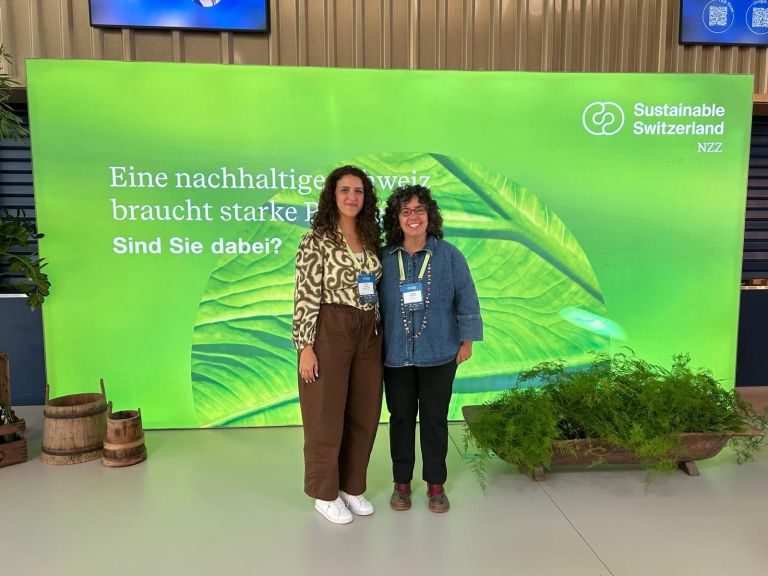
On September 2 2025, Digital for Planet participated in the Sustainable Switzerland Forum 2025, a unique gathering of nearly 500 decision-makers from business, science, and politics, committed to shaping a sustainable future for Switzerland and beyond. Organized by NZZ in collaboration with a number of partners, the forum provided a platform to explore how we can create actionable, systemic change in our society and economy.
This year’s edition was framed around the theme: “United for Sustainability: The Power of Cooperation”. With inspiring keynotes, panels, and cross-sector exchanges, the event spotlighted urgent environmental and social challenges—while also offering optimism, particularly around the role of technology and leadership as critical enablers of change.
Unlocking the Power of Existing Technologies
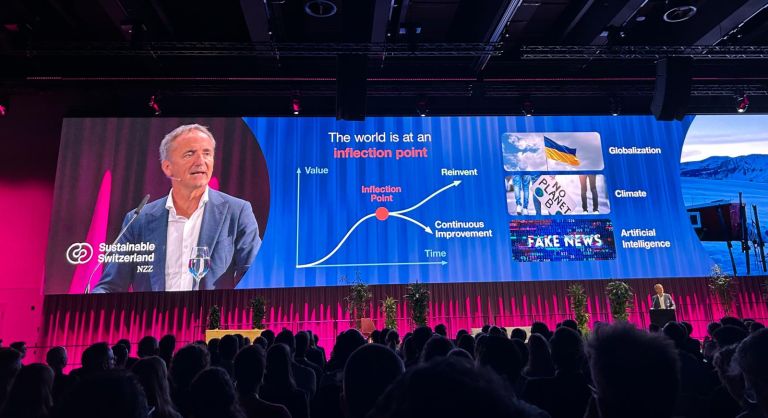
Jim Hagemann Snabe, Chairman of Siemens, delivered a powerful reminder: we already have the technology to solve our biggest global challenges. From decarbonising transport to transforming food and healthcare systems, the solutions are not hypothetical, they’re available today. So why aren’t we using them? It’s not a technology problem, it’s a leadership problem.
We are at a historic inflection point, and leaders must choose between preserving outdated models or using today’s innovations to reshape the future. Referencing the innovator’s dilemma (Christensen, 1997), Snabe argued that we need a mindset shift from viewing sustainability as a cost to recognizing it as a business opportunity.
What we need now is courageous leadership to:
– Build resilient supply chains
– Scale sustainable business models
– Use AI responsibly, not just to optimize, but to solve fundamental problems
Leadership in today’s world is no longer about managing budgets, it’s about unleashing human potential and using existing tools to create meaningful, systemic change.
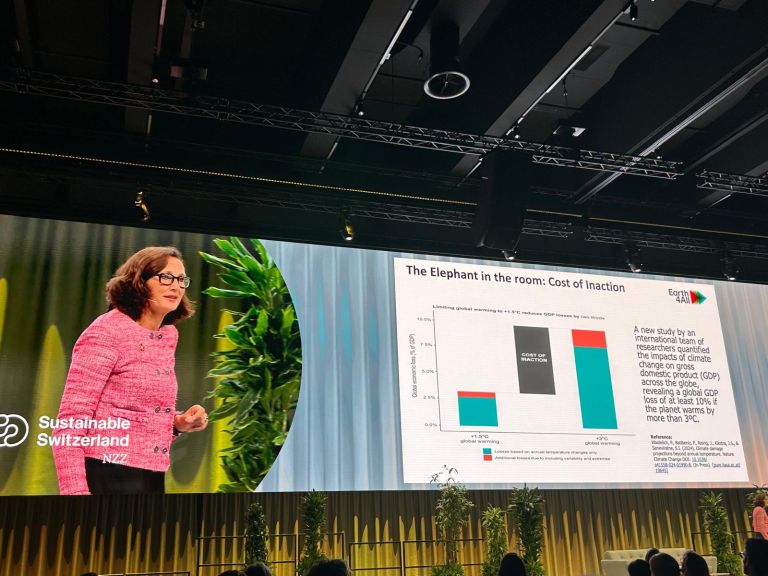
Sandrine Dixson-Declève (Honorary President of the Club of Rome) in a passionate presentation called for more courage to implement profound systemic changes, with no fear or restraint in criticizing our current political leaders and systems. She made the case for ”there is no sustainability without democracy and the rule of law”. Social and environmental tipping points go hand in hand as do solutions. Radical systems change means shifting from an extractive economic model, overhauling our current over-financialised economy, ensuring multidimensional governance from the multilateral to local level. Bringing citizens on the journey is the only way forward and for that we must have the right narratives, storytelling and leadership in place.
Supply Chains and Human Rights: Shared Responsibility
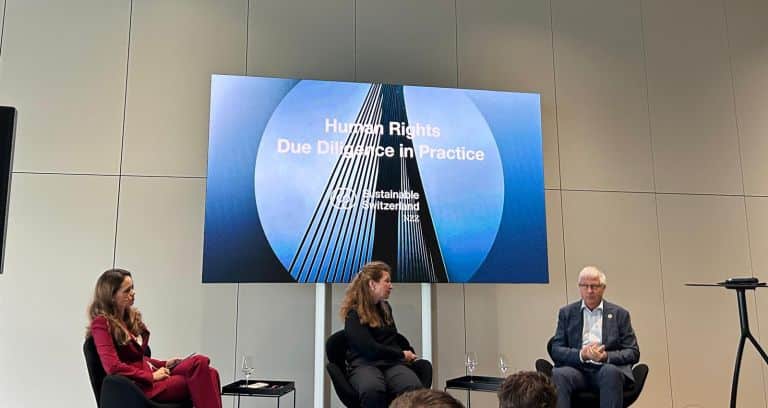
Human rights violations exist across global supply chains, whether we want to acknowledge it or not. Some sectors are at higher risk, but all companies have a duty to act. For Swiss SMEs, which make up 99% of companies, this means focusing on responsible business conduct across economic, environmental, and social pillars.
There’s also a real pressure on SMEs to meet reporting expectations. According to advice shared from Glencore, filling in due diligence questionnaires is tough—especially with limited resources. While AI might help streamline processes, AI alone can’t solve the problem. “AI talking to AI” isn’t a realistic fix for systemic human issues.
Still, there are encouraging examples. Maestrani, a Swiss family business, shows that with committed leadership, long-term responsibility can come before short-term profit. As Antonio Hautle from the UN Global Compact asked: Where do we want to go? Do we want the rule of law, human dignity, and responsible business to be at the centre of our future?
The answer was clear: we won’t step back. Businesses have to stand up for humanity, the environment, and biodiversity, not only because it’s right, but because without these, business cannot go on.
AI & Energy Management
Adam Elman (Sustainability Director, Google) demonstrated how artificial intelligence enables efficiency gains that are both ecologically and economically beneficial. Together with Sebnem Erzan and Max Vogler, Google presented the Contrails project, which uses AI to reduce climate-damaging contrails in air traffic.
A highlight of the forum was the Munk Debate on the Switzerland-EU electricity agreement. Jürg Grossen (National Councilor and President of the GLP) advocated for international integration, while Christian Imark (National Councilor, SVP) and Pierre-Yves Maillard (Council of States, SP) expressed concerns about sovereignty and market liberalization. Anton Gunzinger (Adjunct Professor, ETH Zurich) emphasized the importance of independent solutions and a self-determined timeframe for negotiations. A poll at the end revealed that the vast majority of the attendees are in favor of Switzerland adopting the CH-EU electricity agreement.
Nature, Innovation, and Urgent Global Cooperation : A final message of hope from Costa Rica’s former president
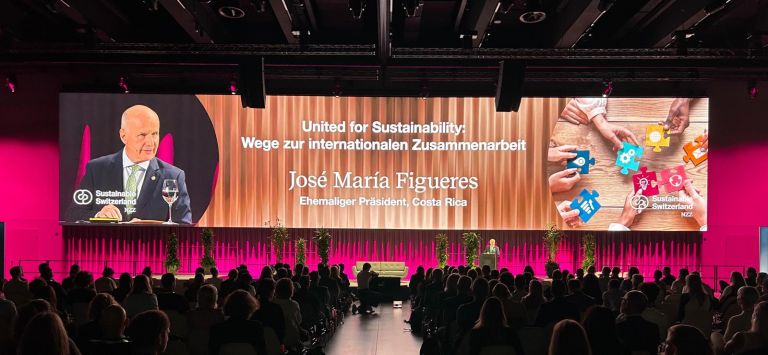
Former President of Costa Rica, José María Figueres, brought a deeply personal and global message about the urgency of protecting our environment, and the unique role of technology and innovation in the transition.
He turned our attention to oceans and Antarctica, the lungs and thermostats of our planet. These ecosystems do things that no human technology can replicate. Yet, ocean warming is accelerating, 2024 and 2025 have registered record high sea temperatures , and 450 million tons of plastic are produced annually, much of it ending up in oceans. Without change, by 2050 there could be more plastic than fish in the sea.
Costa Rica learned this lesson the hard way. After deforesting much of their land, they reversed course in 1995 with a fuel tax that funded environmental services for farmers. Today, over 30% of land and forests are protected. Similar models are being applied to marine conservation.
José María’s message was clear: small shifts matter, and entrepreneurial action is not a solitary journey, it’s collaborative. We must turn regulatory barriers into opportunities, and success must be redefined, not by strength alone, but by foresight, adaptability, and collective action.
His closing remarks carried both urgency and hope: “We are running out of time. But the solutions are already here. Technologies exist. And nature can be resilient—if we give it space to heal.”
A Call for Courage and Collaboration
The Sustainable Switzerland Forum 2025 highlighted not only the challenges ahead but also the remarkable opportunities we have—if we act collectively, and if we choose to lead.
Across all panels, the message was consistent: technology is not the obstacle—leadership is. Whether it’s decarbonising transport, building transparent supply chains, deploying responsible AI, or protecting our oceans, the solutions already exist. What’s needed now is the courage to act, the collaboration to scale, and the values to guide us.
At Digital for Planet, we are proud to contribute to this conversation by championing responsible digital innovation that serves both people and the planet. Forums like this are a powerful reminder that the technology to build a better future is already here—it’s up to all of us to use it wisely and boldly.